
Excavations began in 1952 by the University of Chicago under Oscar Broneer. The Roman temple known as the Palaimonion had a square foundation and a circular open colonnade of eight columns, which can be seen on local coins of the Antonine period. It was built over an underground water conduit , which was said to be the tomb of Palaimon.
 Next to this, beneath the South Stoa the Older Stadium was unearthed. It maybe have been abandoned in 390BC. The
Starting Gate for sixteen runners has radiating grooves. The Temple of Poseidon was a 5th century BC Doric
edifice with a perstyle of six columns by thirteen. The excavator has been quoted as saying that the visitor 'will marvel chiefly, perhaps, at the
thoroughness of its destruction.' A 7th century BC Archaic temple that had stood on the same site, exceptional in its early use of dressed stone, had been
totally destroyed by fire, and the later building also suffered from fire in 394BC, though the circumstances are unknown. It was later re-roofed. A
gigantic statue which formed part of a cult group of Poseidon and Amphitrite was discovered in 1952.
Next to this, beneath the South Stoa the Older Stadium was unearthed. It maybe have been abandoned in 390BC. The
Starting Gate for sixteen runners has radiating grooves. The Temple of Poseidon was a 5th century BC Doric
edifice with a perstyle of six columns by thirteen. The excavator has been quoted as saying that the visitor 'will marvel chiefly, perhaps, at the
thoroughness of its destruction.' A 7th century BC Archaic temple that had stood on the same site, exceptional in its early use of dressed stone, had been
totally destroyed by fire, and the later building also suffered from fire in 394BC, though the circumstances are unknown. It was later re-roofed. A
gigantic statue which formed part of a cult group of Poseidon and Amphitrite was discovered in 1952.
 After the sack of Corinth, the site fell into decrepitude, and traces of a wagon road passing across its altar can be seen,
to be restoed by Tiberius during the 2nd century AD. The Temenos (sacred precinct) was extended, and the
After the sack of Corinth, the site fell into decrepitude, and traces of a wagon road passing across its altar can be seen,
to be restoed by Tiberius during the 2nd century AD. The Temenos (sacred precinct) was extended, and the  temple area surrounded by stoas, paid for by the high priest, P. Licinius Priscus. The
Theater was built in the 4th century BC in an artificial hollow, (which is now cultivated with crops) half way between the temenos and the Isthmian
Wall. Nothing remains of the original, the structure later modified several times. Its roof tiles are stamped with the name of Poseidon or with a dolphin and
trident. This is the spot where Nero gave his speech on the liberation of Greece. The remains of the huge Roman baths are
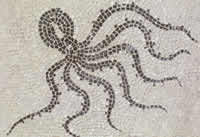
visible only from the fence, where ecavations since 1975 unearthed the Great Hall with a wonderful mosaic floor, an elaborate hypocaust
(heating system with pipes under the floors, and traces of a pool. The Later Stadium is southeast of the Sanctuary, on the opposite side of
the road and in a gully. It is larger than the first one and was in use from around 390 until 146BC. In 1960, the starting line was found at
the open end. Past the stadium on the slope are traces of a Cyclopean Wall dating from the end of the Mycenaean period, which
may have just been the retaining wall of a road.
temple area surrounded by stoas, paid for by the high priest, P. Licinius Priscus. The
Theater was built in the 4th century BC in an artificial hollow, (which is now cultivated with crops) half way between the temenos and the Isthmian
Wall. Nothing remains of the original, the structure later modified several times. Its roof tiles are stamped with the name of Poseidon or with a dolphin and
trident. This is the spot where Nero gave his speech on the liberation of Greece. The remains of the huge Roman baths are
visible only from the fence, where ecavations since 1975 unearthed the Great Hall with a wonderful mosaic floor, an elaborate hypocaust
(heating system with pipes under the floors, and traces of a pool. The Later Stadium is southeast of the Sanctuary, on the opposite side of
the road and in a gully. It is larger than the first one and was in use from around 390 until 146BC. In 1960, the starting line was found at
the open end. Past the stadium on the slope are traces of a Cyclopean Wall dating from the end of the Mycenaean period, which
may have just been the retaining wall of a road.

Why not enjoy Harry's Free Musical Compositions while you read this site? (opens seperately)
©Harry's Greece Travel Guides