
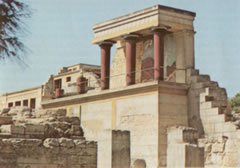
 Minoan ruins all seem to date from around the same period and show traces of fire. There are at least three major Minoan sites on Crete with the most famous, Knossos (left) just outside of Heraklion Crete's modern capitol. The dig at Knossos was funded and excavated by Sir Arthur Evans, a contemporary of Hienrich Schlieman (below). Schlieman actually hunted down and discovered Troy but in the case of Mycenae the ruins were partially visible he just had to go uncover them. A lot of people give Schlieman a bad rap but they are just jealous. You can visit his house here in Athens too! Its a museum now - the numismatic museum to be exact but is a beautiful building in and of its self!
 Before the Mycenaean's moved into Greece other people lived here too but far fewer. Since they left no written record very little is known about them. Pre-Greek place names were akin to those of Asia Minor and races such as the Pelasgians,
Leleges, Carians, Dryopes, Tyrrhenians, Egocretans, and the Minyans who
inhabited areas of the Aegean and mainland Greece.
Before the Mycenaean's moved into Greece other people lived here too but far fewer. Since they left no written record very little is known about them. Pre-Greek place names were akin to those of Asia Minor and races such as the Pelasgians,
Leleges, Carians, Dryopes, Tyrrhenians, Egocretans, and the Minyans who
inhabited areas of the Aegean and mainland Greece.
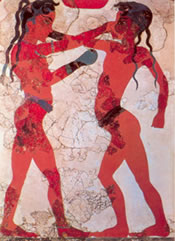
Cycladic Wall mural from Santorini (left) National Archeology Museum Athens.
Neolithic settlements have been discovered in Thessaly (N. Greece) and in Macedonia and Crete. The finds from the German Archeological Institute during 1956-59 show traces of 100,000 year old inhabitation at Argissa in Thessaly. (Volos Museum)
Ancient History Page One | Two | Three | Four | Five | Six | Seven | Eight

Why not enjoy Harry's Free Musical Compositions while you read this site? (opens seperately)
©Harry's Greece Travel Guides