
 She was royalty and so beautiful that royal suitors would come from near and far
to woo her. There were so many of these suitors that Agamemnon, with Odysseus'
help devised a pledge which all suitors had to swear to before the husband
to be was chosen. This pledge bound them to uphold Helen's honor and to defend
it no matter who was chosen. They figured that way no powerful princes would
get annoyed enough to start a war. This was a pretty smart idea actually and
although disappointed the suitors went their separate ways for quite a few
years until Helen got "abducted". It was fortunate for Agamemnon
that the "abductor" just happened to be a son of the troublesome
King of Troy, Priam.
She was royalty and so beautiful that royal suitors would come from near and far
to woo her. There were so many of these suitors that Agamemnon, with Odysseus'
help devised a pledge which all suitors had to swear to before the husband
to be was chosen. This pledge bound them to uphold Helen's honor and to defend
it no matter who was chosen. They figured that way no powerful princes would
get annoyed enough to start a war. This was a pretty smart idea actually and
although disappointed the suitors went their separate ways for quite a few
years until Helen got "abducted". It was fortunate for Agamemnon
that the "abductor" just happened to be a son of the troublesome
King of Troy, Priam.
 Now Priam felt threatened by the Greeks to his west and would levy really
large tolls on Greek shipping if he let them through at all.
The real reason for the war against Troy (and all wars) was economic. The
theory is that the Trojans controlled the straits of the Dardanelle's and
access to the tin and other minerals necessary to change from a bronze to
an iron age culture. (Read that as having better weapons). Theorists attribute
the Dorian ascendance over the Minoan to their iron weapons as well.
Now Priam felt threatened by the Greeks to his west and would levy really
large tolls on Greek shipping if he let them through at all.
The real reason for the war against Troy (and all wars) was economic. The
theory is that the Trojans controlled the straits of the Dardanelle's and
access to the tin and other minerals necessary to change from a bronze to
an iron age culture. (Read that as having better weapons). Theorists attribute
the Dorian ascendance over the Minoan to their iron weapons as well.
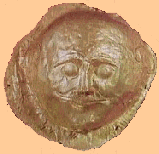
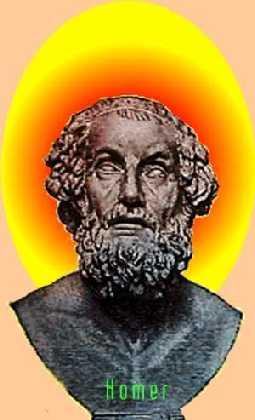
Left is a bust of Homer who is thought to have been blind. You can see these masks and more in the National Archeology Museum in Athens. As mentioned a little earlier, Helen was married to Menelaous, King of Argos which is just down the road from Mycenae and also Agamemnon's brother. If we assume a family resemblance, and that's him above left in another death mask found at Mycenae, we now we know why she ran away!
Not a bronzed Adonis was he?! In the Iliad he was no slouch on the battlefield, however. Also, Argos wasn't exactly know for its beauty salons and creature comforts either. In the Iliad we see Helen bitterly regretting, in public anyway, her decision. In private Homer gives us a peek at the early Mediterranean blood in action.
Ancient History Page One | Two | Three | Four | Five | Six | Seven | Eight

Why not enjoy Harry's Free Musical Compositions while you read this site? (opens seperately)
©Harry's Greece Travel Guides