
 This music overlapped in the 1920s and early 30s with the music known as rembetika ( and sometimes even referred to as early Rembetika) though the instruments included some that had been played formerly in Asia Minor, but not in Greece).
The classic Rembetika music that supplanted the earlier ‘Smyrneika’ by the 1930s, was musically very different , in that it centered around instruments that had fixed frets (bouzouki, baglama and guitar), even though the bouzouki and baglama were basically variants of the Turkish saz, whose frets were movable, which allowed for the playing of microtones involved in Anatolian modes connected with Persian, Arabic, Byzantine and Turkish modal systems.
Certainly too, the focus in the Rembetika that preceded the World Wars on hashish and hashish dens (called ‘tekes’) , and the many songs related to hashish smoking (hasiklidhika), comes from Anatolia (Asia Minor), where hashish, and the water pipe in which it was smoked, was legal and accepted.
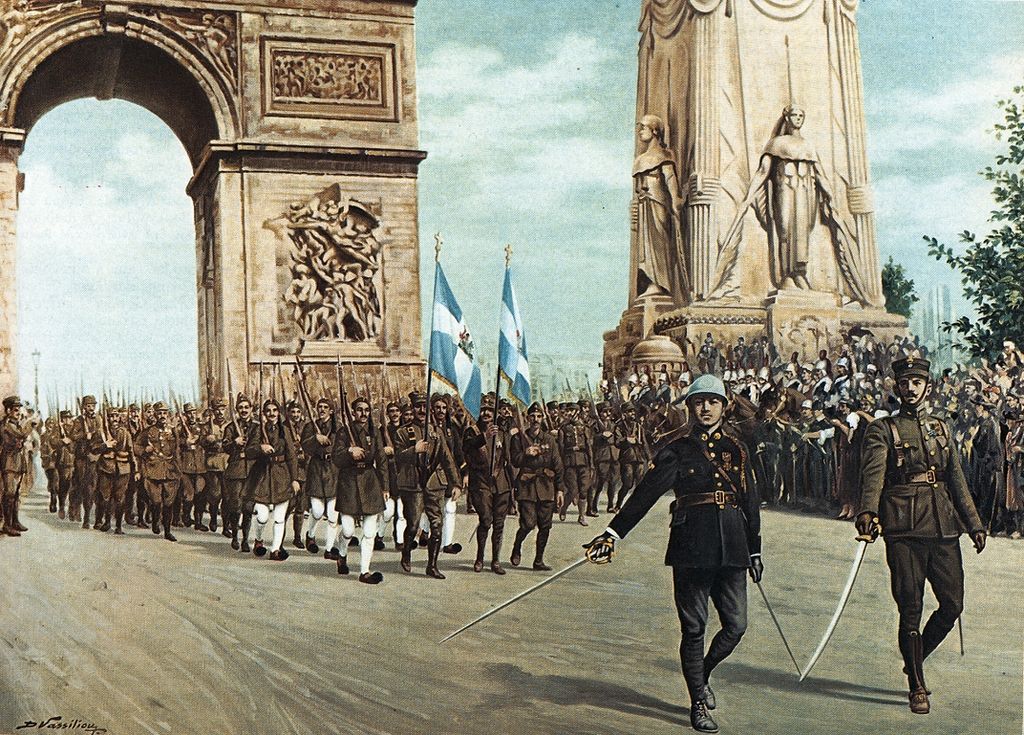 In 1920, King Konstandinos was restored to the throne, after his son Alexander died of a monkey bite, though he soon abdicated (being invited to do so by Venizelist army officers, who then executed six of his ministers, blaming the administration for the Katastrofi) .
Factions within the army ruled during most of the following decade, with a republic proclaimed in 1924 along with a series of coups and counter-coups. In 1928 Venizelos returned to power and it was then that he instituted educational and economic reforms, though much hampered by the Great Depression, which had serious financial repercussions as he had borrowed abroad and could not renegotiate loan terms.
This combined with the abandoning of the gold standard by England, resulted in devalued currency in Greece. He was defeated by monarchist elements in 1933, his supporters responded by staging a coup in 1936, though unsuccessfully, and was exiled to Paris, dying there a year later.
A rigged plebicite a year later restored George II to the throne, who appointed the right wing general, Ioannis Metaxas as prime minister, who, nine months later, usurped the government in dictatorial fashion. Metaxas set up a fascist government which imposed censorship of the press and imprisoned or forced into exile left-wing and trade union opponents, set up a state youth movement and secret police.

Why not enjoy Harry's Free Musical Compositions while you read this site? (opens seperately)
©Harry's Greece Travel Guides