
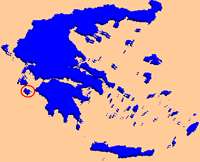
 Zakynthos
Town is the capital and port. The
center of town is the large and formal harborside square of Platea
Solomou named after Zakynthos' famous poet and author of the Greek
National Anthem, Dionysios Solomos.
Zakynthos
Town is the capital and port. The
center of town is the large and formal harborside square of Platea
Solomou named after Zakynthos' famous poet and author of the Greek
National Anthem, Dionysios Solomos.
 You'll see his statue
waving
at you in the square as well as the statue of fellow poet and Zantiote
Ugo Foscolo with its inscription 'Liberty requires Virtue
& Daring' just outside the Town Hall.
You'll see his statue
waving
at you in the square as well as the statue of fellow poet and Zantiote
Ugo Foscolo with its inscription 'Liberty requires Virtue
& Daring' just outside the Town Hall.
Also in the square is the Cultural Center and the Sailor's Church, Aghio Nicolaou tou Molou (of the Mole, ie. quay). The church was rebuilt painstakingly after the quake.


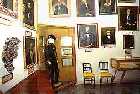
The Neo-Byzantine Museum also resides in the
square (8-2:30, closed Mon, fee, free on Sun). The Museum is one of
the best of its kind as Zakynthos had many fine artists and the refugees
from Crete only added to their skills. Additionally, there are ancient finds
from around the island and momentoes from the War for Independence.
 The social center of town
life is Platea Aghious Markou or St. Marks Square. It's located back
from the harbor. Here are several good restaurants, cafes and the Solomos
Museum with momentoes of his life as well as those of other famous islanders.
You can see pictures of pre-quake Zakynthos.
The social center of town
life is Platea Aghious Markou or St. Marks Square. It's located back
from the harbor. Here are several good restaurants, cafes and the Solomos
Museum with momentoes of his life as well as those of other famous islanders.
You can see pictures of pre-quake Zakynthos.
 A
45 minute walk up the cobbled path behind Platea Markou (or a short
taxi ride from town) through the picturesque suburb of Bochali will bring you to the ruined
Venetian Fortress (8-8, fee) with its crest
of St. Mark, set amidst pine trees.
A
45 minute walk up the cobbled path behind Platea Markou (or a short
taxi ride from town) through the picturesque suburb of Bochali will bring you to the ruined
Venetian Fortress (8-8, fee) with its crest
of St. Mark, set amidst pine trees.
Completed in 1646 on the site of the ancient Acropolis of Psophidas (of which little remains) it has borne the brunt of earthquke damage. Nearby are ruins of midieval Venetian, Greek and British villas. Repairs were carried out in 1812 by the British who laid out the very first tennis court in Greece close by.

Why not enjoy Harry's Free Musical Compositions while you read this site? (opens seperately)
©Harry's Greece Travel Guides